

Blog | 28 Apr,2026
Why Digital Governance Is the Key to Unlocking Pakistan True Potential
By:
WQsoftwares
Category:
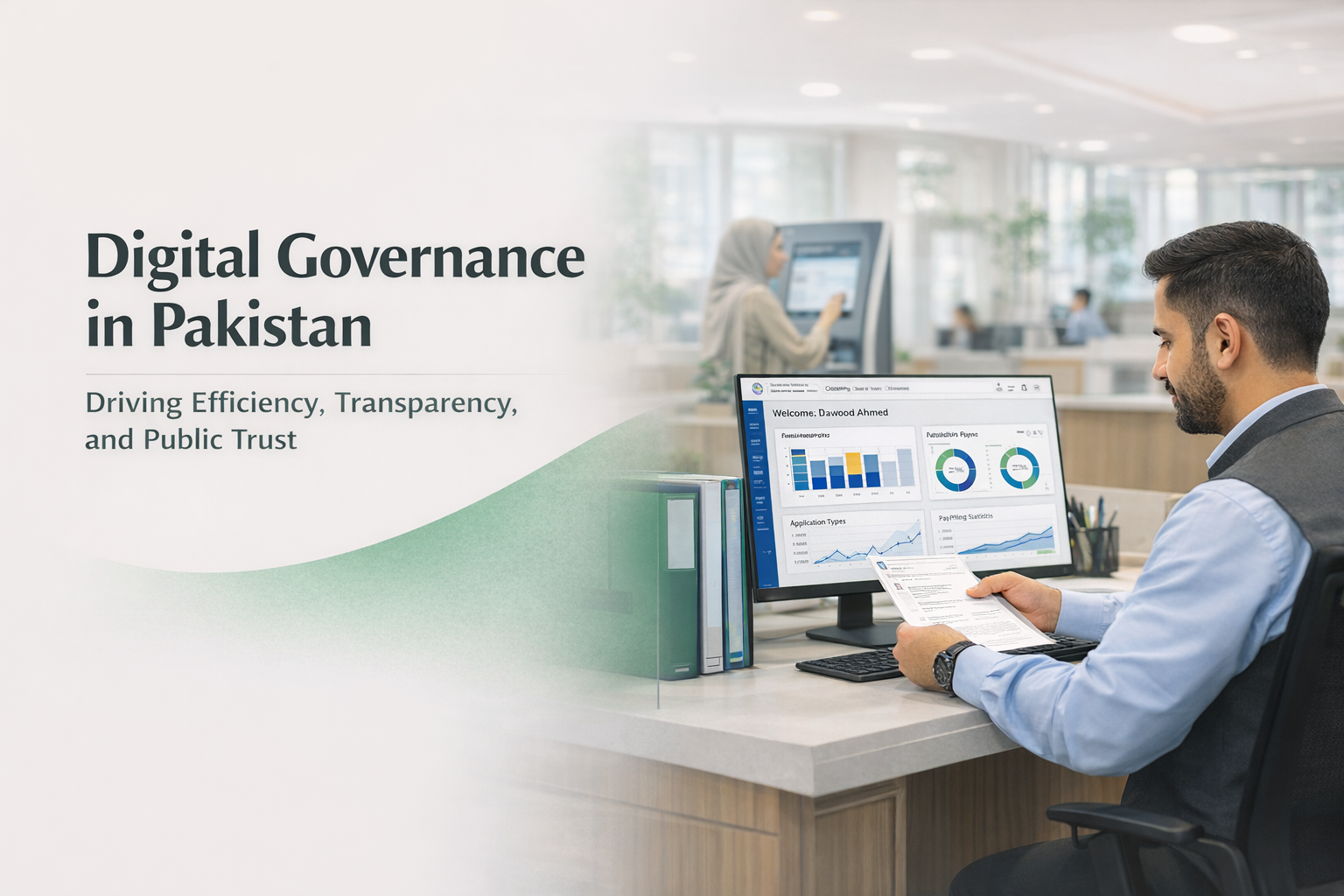
Pakistan stands at a crossroads. On one path lies the familiar comfort of paper-based systems slow, opaque, and prone to friction. On the other lies a future where a citizen in a remote village can access her land record from her mobile phone, where a small business owner can register his company in hours rather than months, and where the state can respond to a climate disaster with real-time data and precision. This is not merely about convenience. It is about whether Pakistan can build the kind of state its people deserve one that is efficient, equitable, and trustworthy. Digitisation in governance matters because governance is the operating system of a nation. When that system is slow and fragmented, the entire country pays the price. When it is fast, transparent, and data-driven, everything accelerates economic growth, social equity, and public trust. For Pakistan, a country of over 240 million people with a young, connected population, the question is no longer whether to digitise governance, but how quickly we can do so because the cost of delay is measured in lost opportunity, eroded trust, and missed potential.
The Foundation of the State-Citizen Relationship
At its core, governance is a relationship. Citizens pay taxes, follow laws, and look to the state for services, security, and justice. In return, they expect fairness, efficiency, and dignity. When a citizen must travel to three different government offices over two weeks to renew a simple license, that relationship frays. When a family must pay a bribe to expedite a land transfer that exists only in a faded physical ledger, the state loses its moral authority.
Digitisation restores that trust. When processes are automated, discretion is replaced with rules. When services are available online, the need for intermediaries and the opportunities for rent-seeking diminishes. When every transaction is logged and traceable, accountability becomes possible. A digital state is not just a more efficient state; it is a more just state.
This is not theoretical. In Punjab, the digitisation of land records through the Punjab Land Records Authority has given millions of citizens, especially women the ability to verify ownership without navigating a system historically dominated by discretionary power. In Khyber Pakhtunkhwa, the expansion of digital services has begun to reduce the friction that once defined routine government interactions. These are early signs of what happens when the state chooses transparency over opacity.
Economic Growth: Unlocking Productivity and Investment
A nation's economy cannot outrun its governance systems. When starting a business requires navigating layers of manual approvals, capital sits idle. When tax filing is cumbersome, compliance drops. When land ownership is uncertain, banks hesitate to lend. Every manual process is a drag on productivity.
Pakistan's tax-to-GDP ratio remains among the lowest in the region not because Pakistanis do not want to contribute, but because the cost of compliance is too high and the perception of fairness too low. Digitisation changes this equation. When tax systems are seamless, when refunds are automated, when businesses can file and pay without visiting an office, compliance rises. The evidence is clear: countries that have digitised their tax administrations have seen significant increases in revenue collection without raising rates.
Similarly, when land records are digitized and accessible, property becomes collateral. Credit flows. Small businesses grow. Investment both domestic and foreign follows certainty. A digital governance framework signals to investors that the state is predictable, that contracts will be honored, and that disputes will be resolved through systems, not discretion.
Climate Resilience: A Matter of Survival
For Pakistan, digitisation in governance is not just about efficiency it is about survival. As one of the most climate-vulnerable nations in the world, Pakistan faces floods, heatwaves, and droughts with increasing frequency. The floods of 2022 were a devastating reminder that when physical infrastructure is compromised, the state's ability to respond depends on its digital infrastructure.
With digital identity systems, emergency cash transfers can reach affected families within hours, not days. With satellite mapping and real-time data dashboards, authorities can anticipate flood risks and coordinate evacuations with precision. With integrated health information systems, disease outbreaks in displacement camps can be tracked and contained. Digitisation transforms disaster response from reactive to proactive, from chaotic to coordinated.
This is why investing in digital governance is an investment in climate adaptation. It is the difference between a state that is overwhelmed by a crisis and a state that is prepared for it.
Inclusion: Leaving No One Behind
Pakistan is a country of stark contrasts. Alongside its thriving tech hubs and young, digitally native population, there are millions who remain disconnected. Digitisation in governance must not mean disenfranchisement. When done right, digital governance is one of the most powerful tools for inclusion.
A woman in a rural area who can access her land record from a mobile phone no longer needs to rely on a male relative to navigate a physical government office. A person with a disability who can apply for a disability certificate online no longer faces the barrier of inaccessible government buildings. A family in a remote district who can register a birth digitally ensures that the child's right to identity, education, and healthcare is secured from the very beginning.
The goal is not to replace human interaction with screens, but to ensure that every citizen regardless of geography, literacy, or socioeconomic status has equal access to the state. Hybrid models that combine digital portals with physical facilitation centers ensure that no one is left behind.
The Cost of Inaction
If the case for digitisation is compelling, the case against inaction is urgent. Every year that Pakistan delays full-scale digital governance is a year of lost productivity, diminished trust, and missed opportunities.
The data tells a clear story. At the federal level, the E-Office initiative has already reduced summary processing time from 25 days to just 4 days, an 84% reduction and generated annual savings of approximately Rs 9.5 billion. These are not projections; they are results. They demonstrate what is possible when systems are digitized. Yet, across the country, only 15–20% of public sector organizations are IT-based, and federal IT spending remains a fraction of global benchmarks. The gap between what is possible and what is current is vast but it is also bridgeable.
A Call to Action
Digitisation in governance matters because the quality of governance determines the quality of life. It matters because trust in the state is the bedrock of a functioning society. It matters because economic growth cannot outrun administrative friction. It matters because climate resilience depends on real-time data and rapid response. And it matters because every citizen whether in Karachi or Kalat, Lahore or Loralai deserves a state that works for them with speed, fairness, and dignity.
Pakistan has the talent. Its young population is digitally fluent, its IT sector is thriving, and the foundations of digital governance are already being laid across federal and provincial governments. What is needed now is urgency. Not incremental progress, but a decisive acceleration. Not isolated pilot projects, but systemic integration. Not a future vision, but a present commitment.
The era of the paper file must end. The era of digital governance, transparent, efficient, and inclusive, must begin. For Pakistan, this is not just a reform agenda. It is the key to unlocking the nation's true potential.
Tags:
